Subscription Economy in 2025: Trends, Challenges, and Consumer Expectations
The subscription economy is booming, with global revenue projected to surpass $1.5 trillion by 2025. But with growth comes challenges: 52% of consumers canceled a subscription last year, and 42% feel overwhelmed by managing multiple services. Businesses are shifting to hybrid pricing models and using AI-powered tools to improve customer retention and personalization. Meanwhile, consumers demand transparent pricing, simple cancellations, and more control over their subscriptions.
Key highlights from the article:
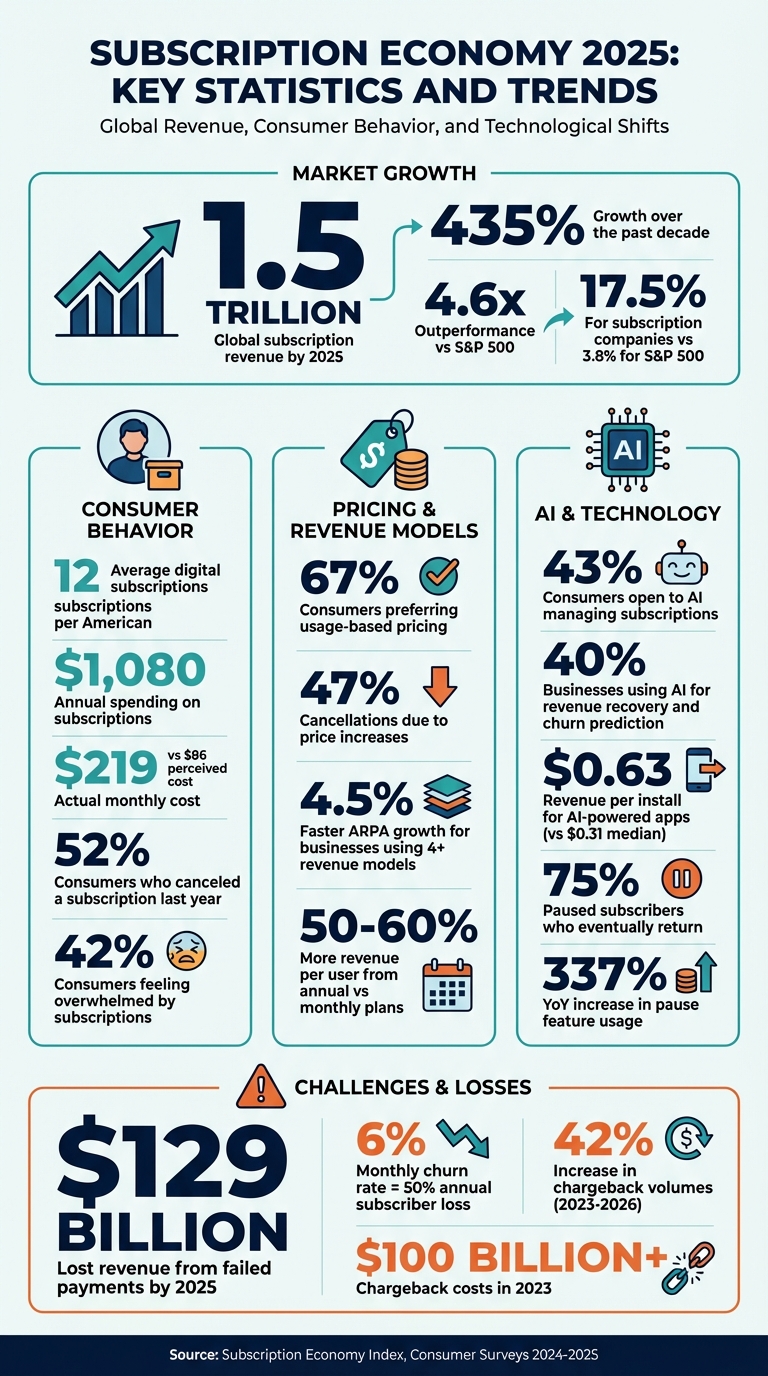
- Market Growth: Subscription businesses have grown 435% over the past decade, outperforming the S&P 500 by 4.6x.
- Hybrid Pricing: 67% of consumers prefer usage-based pricing, driving businesses to mix flat fees with pay-per-use models.
- AI in Retention: 43% of consumers are open to AI managing subscriptions, while businesses use AI to prevent churn and recover failed payments.
- Challenges: Subscription fatigue, billing issues, and $129 billion in lost revenue from failed payments are major hurdles.
- Consumer Priorities: Transparency, easy cancellations, and pause options are critical for loyalty.
The subscription economy's future depends on balancing flexibility with revenue stability, leveraging AI, and meeting rising consumer expectations.
Subscription Economy 2025: Key Statistics and Consumer Trends
Major Trends in the 2025 Subscription Economy
Market Growth and Revenue Projections
The subscription economy is on track to exceed $1.5 trillion globally by 2025. This growth reflects a shift in consumer priorities, as more people gravitate toward "participation over possession", favoring access to services and experiences over outright ownership.
Financial data backs up this trend. Companies in the Subscription Economy Index have achieved a compound annual growth rate (CAGR) of 17.5%, far outpacing the S&P 500's 3.8%. Between 2022 and 2024, these companies saw a 25% increase in unique subscribers and revenue growth that was 11% faster than the broader market. Additionally, 68% of consumers surveyed in early 2025 said they subscribed to a new service for the first time in 2024, underscoring the sector's ongoing expansion.
This rapid market growth has pushed businesses to rethink how they price their services.
Usage-Based and Hybrid Pricing Models
Gone are the days of one-size-fits-all pricing. Many companies are now leaning into hybrid pricing models, blending flat subscription fees with usage-based charges. Businesses using four or more revenue models have reported 4.5% faster average revenue per account (ARPA) growth compared to those relying on a single pricing strategy.
Consumer preferences are also driving this shift. Sixty-seven percent of consumers favor usage-based pricing over flat fees, and nearly half of those who canceled a subscription in 2024 (47%) cited price increases as the main reason. This has led to the rise of "utility bill" pricing, where customers pay based on their actual usage. Mark Thomason, Former Senior Research Director at IDC, notes:
"When executed well, the hybrid model secures predictable revenue and scales pricing with delivered value".
Looking ahead, analysts predict that by 2027, more than half of enterprises will adopt mixed revenue models, combining subscriptions, usage-based pricing, and one-time sales to stay competitive. Companies like Gousto, a UK-based meal kit service, are already embracing this trend. Gousto uses a proprietary algorithm - dubbed the "Spotify of food" - to offer personalized meal recommendations, enhancing both customer satisfaction and business growth. These pricing innovations reflect a broader effort to meet evolving consumer expectations while ensuring steady revenue streams.
AI-Powered Personalization and Customer Retention
AI is playing a growing role in shaping customer experiences and retention strategies. As of now, 43% of consumers are comfortable with AI managing their subscriptions, and 50% are open to using it for personalized content recommendations. On the business side, 40% of companies are leveraging AI for tasks like revenue recovery and churn prediction. AI-powered apps are also proving lucrative, generating over $0.63 in revenue per install within 60 days - double the overall median of $0.31.
AI's real strength lies in its ability to act proactively. Machine learning models can identify early warning signs, such as reduced login activity or skipped deliveries, allowing companies to address issues before they lead to cancellations. For example, businesses offering "pause before cancel" options have seen a 337% year-over-year increase in paused subscriptions, with 75% of those subscribers eventually resuming their service. This approach highlights the importance of flexibility, retention, and automation.
Generative AI is also gaining traction. Consumer use of GenAI services jumped from 28% to 40% between May 2024 and January 2025, though 64% of consumers remain hesitant to pay extra for these tools. The next big leap - referred to as "agentic AI" - involves systems that don’t just analyze data but also take autonomous actions. These systems can recover failed payments, personalize offers in real time, and shift subscription management from a reactive to a predictive process. By adopting these AI-driven strategies, companies can deliver the transparency and tailored experiences that modern consumers expect.
sbb-itb-5d40823
The 2025 State of Subscription Apps Report: Sub Club Podcast
Challenges Facing Businesses and Consumers
As the subscription market continues expanding, it brings a host of challenges for both businesses and consumers. From subscription fatigue to billing errors, these issues are reshaping how companies manage customer retention and revenue streams.
Subscription Fatigue and Cancellation Rates
The rapid growth of subscription services and shifting pricing strategies have led to a noticeable trend: subscription fatigue. On average, Americans juggle 12 digital subscriptions and spend about $1,080 annually on these services. Alarmingly, $200 of that goes toward subscriptions they don’t even use. Adding to this, there’s a significant gap between what consumers think they’re spending and what they actually pay. While they estimate their monthly subscription costs at $86, the real figure is closer to $219. This "visibility gap" fuels frustration, with 87% of Gen Z reporting feelings of subscription fatigue.
For businesses, the financial stakes are equally high. A monthly churn rate of 6% means companies risk losing half their subscribers annually. Price sensitivity compounds the issue - 60% of consumers say they’d cancel their favorite streaming service over a $5 price hike. On top of that, failed payments due to expired cards or processing errors could result in $129 billion in lost revenue by 2025.
Interestingly, churn isn’t always permanent. Over half (50.5%) of customers report resubscribing to services they’ve previously canceled, suggesting that many cancellations are temporary. Gen Z, in particular, has embraced a behavior called "intentional cycling", where they subscribe to watch specific content and cancel immediately afterward.
Payment Disputes and Recurring Billing Issues
Payment disputes and billing errors are another major challenge. Between 2023 and 2026, chargeback transaction volumes are expected to rise by 42%. In 2023 alone, businesses faced over $100 billion in chargeback costs. These disputes often stem from technical errors like accidental double charges, failed cancellations, or unclear billing descriptions on statements.
The consequences of high chargeback rates can be severe. For example, Mastercard imposes penalties on businesses with chargeback rates exceeding 1.5%. As Recurly highlights:
"Elements like easy cancellation, transparent billing, and 'pause' options are no longer just features - they are the primary drivers of loyalty".
Fortunately, automated recovery tools are helping mitigate these losses. In 2025, the software industry recovered over $155 million in revenue using these tools. Additionally, 56% of consumers now trust AI to manage their subscriptions for fraud prevention. However, the need for clear and flexible billing practices remains a delicate balancing act for businesses.
Flexibility vs. Revenue Stability
Striking a balance between offering flexibility and maintaining steady revenue is a persistent challenge. Hybrid pricing models, while effective for growth, add complexity to this equation. With acquisition rates stabilizing at around 3%, businesses are shifting their focus from a sales "funnel" approach to a "lifecycle" strategy, emphasizing retention and flexibility. Consumers, for their part, value the ability to pause or cancel subscriptions more than immediate savings.
This creates a paradox. While rigid plans can drive cancellations, overly flexible options like weekly plans may see churn rates as high as 65% within the first 30 days if not paired with upselling strategies. Offering too many pricing tiers can also backfire, as mid-tier plans often have the highest refund rates (3.24%) due to buyer’s remorse and decision paralysis. Victoria Kharlan of Adapty explains:
"Users overwhelmed by subscription fatigue are gravitating toward options that feel less risky, more flexible, and easier to escape".
Flexibility, however, can be a powerful tool when applied wisely. Businesses offering "pause before cancel" options have seen a 337% year-over-year increase in pause usage, with 75% of paused subscribers eventually returning. On the other hand, annual plans generate 50–60% more revenue per user than monthly plans, though they sacrifice some flexibility. Companies that align pricing with customer outcomes using value metrics have also outpaced their peers, growing revenue 1.6 times faster than those relying on standard unit-based pricing.
What Consumers Expect in 2025
Consumer expectations are evolving quickly. Subscribers today aren't just after attractive deals - they want control, transparency, and respect for their time and money. Companies that fall short in these areas risk higher cancellation rates.
Transparent Pricing and Ethical Practices
Pricing transparency is non-negotiable. A notable 31% of subscribers say they would cancel a service if it renewed without their explicit approval, while 40% of those who canceled subscriptions pointed to unexpected changes in shipping costs as their primary reason. What are consumers asking for? Simple things: advance notifications about renewals, clear explanations of price changes, and honest communication about what their money is going toward. Price sensitivity is still a factor, but 84% of subscribers feel their current subscriptions are worth the cost, and 34% even say they’ve seen increased value over the past year.
Ethical practices go beyond just billing. Consumers are increasingly drawn to brands that align with their values, including those offering eco-friendly packaging and carbon-neutral shipping options. This alignment often fosters stronger loyalty. Amanda Mesler, Chair and CEO of Minna Technologies, emphasizes this point:
"Businesses need to focus on enhancing flexibility, convenience and control for customers".
This focus on clarity and ethics naturally extends to the way companies handle cancellations and disputes.
Simple Cancellations and Dispute Resolution
Transparency isn’t enough - cancellation processes must also be simple and straightforward. Customers expect canceling a subscription to be as easy as signing up for one. The FTC's "Click to Cancel" Rule, which will be fully enforced by May 2025, ensures this by requiring cancellation methods to match the ease of enrollment. Companies that violate this rule could face civil penalties of up to $53,088 per violation. A recent example: in early 2025, the FTC reached a $17 million settlement with Cleo AI over deceptive subscription practices and failure to provide simple cancellation options.
Interestingly, making it easy to leave can actually boost loyalty. "Pause before cancel" features saw a 337% increase in usage year-over-year, and 75% of subscribers who paused their subscription eventually returned. Additionally, two-thirds of businesses report that up to 20% of users who unsubscribe come back within six months, often drawn by new content or win-back offers.
Consumers also crave centralized control over their subscriptions. Sixty-one percent want to manage all their subscriptions in one place, like their banking app, and this figure rises to 80% among Gen Z and Millennials. However, only 2% currently use such solutions. When given alternatives to cancellation, many subscribers opt to stay: 63% for promotional offers or discounts, 46% for plan downgrades, and 39% for the option to pause their subscription.
Convenience goes beyond saving money. In fact, 59% of subscribers prioritize ease and enjoyment over cost. By making subscription management simple and flexible, businesses can earn long-term loyalty in a competitive and fast-changing market.
AI-Powered Tools for Subscription Disputes
When disputes over subscriptions can’t be resolved directly with merchants, AI-powered tools are stepping in to help consumers recover their money. These tools quickly analyze transactions, identify the best legal arguments, and create ready-to-use documentation for banks in just minutes.
How DidIBuyIt Helps Recover Disputed Payments
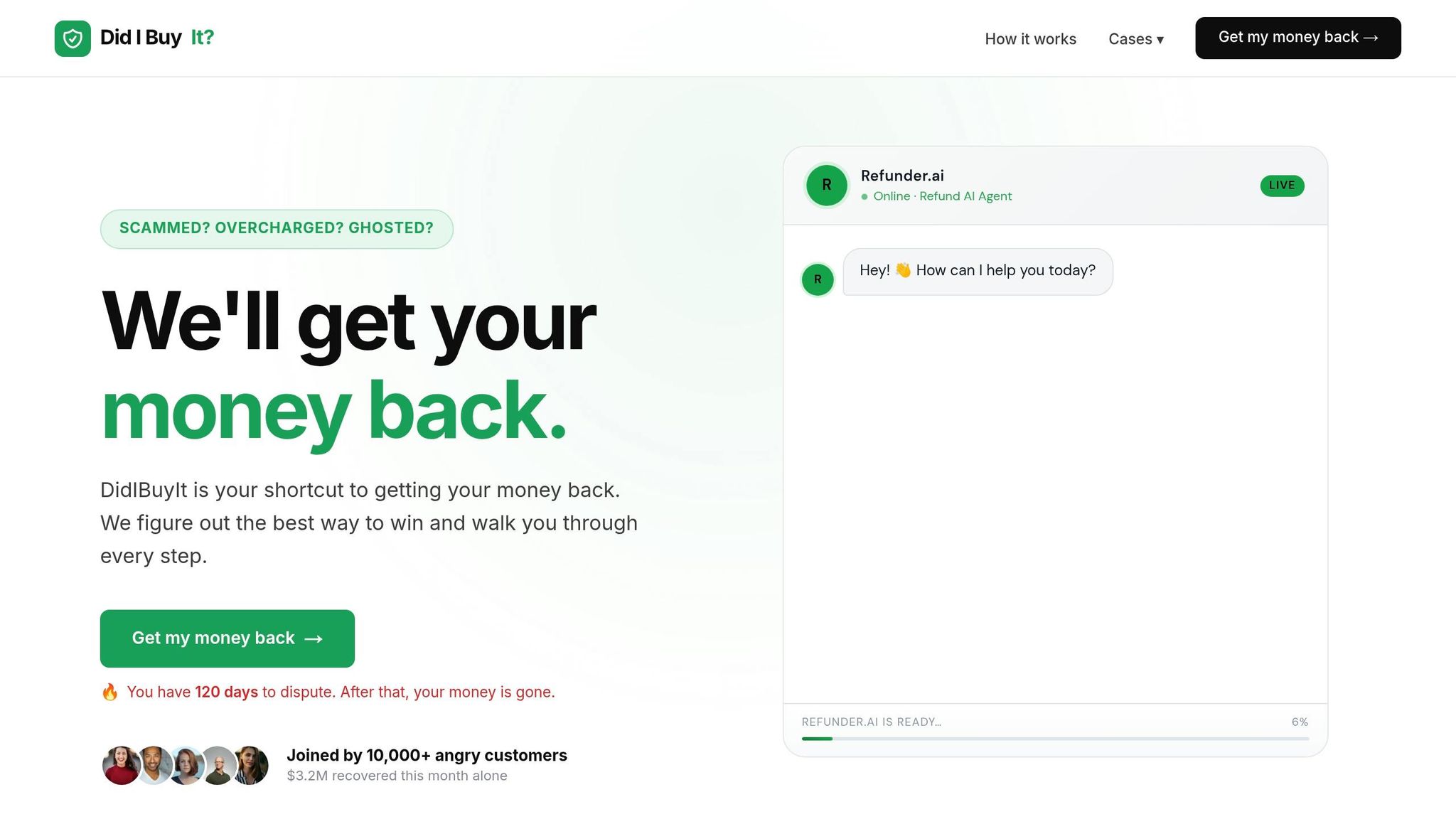
DidIBuyIt leverages AI to classify disputes and pinpoint the precise reason codes required by card networks. Its "Refunder" agent scans bank regulations, Visa and Mastercard rules, and merchant policies to generate bank-ready PDF documents, detailed evidence checklists, and even word-for-word scripts - all in under three minutes. This is a game-changer because 60–80% of chargebacks fail due to incorrect reason codes or missing evidence.
The platform has already filed over 284,000 disputes and recovered more than $18 million for users, achieving an 83% success rate. For example, in April 2026, Sarah M. recovered $599 from Adobe after being charged for a canceled subscription. She built her case in just four minutes, and the bank reversed the charge within six days. Similarly, in March 2026, Raj K. successfully disputed a $1,840 Microsoft Azure overage charge by using the exact reason code and script provided by the AI.
"Azure imposed a $1,840 overage charge. No idea how to frame it as a dispute. Refunder gave me the exact reason code and script. Bank sided with me." - Raj K.
DidIBuyIt also calculates the likelihood of success upfront, using data from thousands of past cases. Additionally, it includes an AI-powered search tool that helps users identify unknown charges by analyzing over 50,000 transaction descriptors.
The platform offers two subscription plans: Basic Recovery, which includes AI analysis, bank-ready documentation, and step-by-step guidance for a flat fee, and Advanced Support, which adds priority assistance and enhanced evidence preparation for more complex cases. Both options feature encrypted data handling and work seamlessly across all major payment platforms.
These tools provide a streamlined way to resolve disputes, as seen in the following strategies.
Effective Methods for Resolving Payment Disputes
Timing is everything. Consumers generally have a 60–120 day window from the transaction date to file a dispute. Waiting too long often results in automatic denials. Before initiating a chargeback, always contact the merchant first, as banks typically require proof of this attempt. Save all relevant chat transcripts, cancellation confirmations, and timestamps as evidence.
Getting the correct reason code is critical. For instance, Visa 13.1 applies to items not received, while Visa 13.3 is specific to canceled recurring subscriptions. Mislabeling a claim - such as marking a charge as "unauthorized" when the issue was a failed cancellation - can lead to instant rejection if the merchant provides login records.
Credit cards generally offer better protection under the Fair Credit Billing Act (FCBA) compared to debit cards, which fall under the Electronic Fund Transfer Act (EFTA). Whenever possible, use a credit card for subscription payments to maximize your rights in disputes.
By automating the recovery process, DidIBuyIt tackles these challenges head-on, complementing broader subscription management strategies.
Connecting AI Tools with Payment Platforms
DidIBuyIt’s capabilities don’t stop at case creation. Its integration with major payment platforms ensures disputes are resolved efficiently. The platform works with all major card networks - Visa, Mastercard, Amex, and Discover - as well as payment processors like PayPal, Apple Pay, Google Pay, Stripe, Klarna, and Venmo.
With global chargeback volume projected to reach 324 million transactions by 2028, a 24% increase from 2025, automation is becoming essential. DidIBuyIt’s automated reason coding addresses one of the main causes of dispute failure by matching each case to the exact numeric codes required by banks. In 2025 alone, Visa handled 106 million disputes globally, marking a 35% rise since 2019. As U.S. merchants lose an estimated $4.61 for every $1 in chargebacks, efficient tools like these are essential for both consumers and businesses.
Practical Advice for Businesses and Consumers
The subscription economy has shifted gears, requiring businesses to focus on keeping existing customers happy and consumers to find better ways to manage their growing list of services. With subscriber acquisition rates dropping from 4.1% in 2021 to 2.8% in 2025, businesses are prioritizing retention strategies. Meanwhile, households juggle an average of 12 digital subscriptions. Here's how both groups can navigate these changes effectively.
For Businesses: Improving Customer Retention
With existing customers generating 70% of revenue, retaining them is more important than ever. To tackle this, businesses are adopting strategies like offering flexibility. For example, allowing customers to "pause" subscriptions has grown in popularity - usage of this feature has jumped by 337%. Notably, 25% of subscribers opt to pause instead of canceling, while 27% say they'd quit if pausing or skipping weren’t options.
"Even as customer acquisition declines, retention is increasing - a clear sign that consumers want to find and stick with subscriptions that best fit in with their lives." - Joe Rohrlich, CEO at Recurly
Another key focus is payment recovery. AI-powered dunning systems have proven to recover up to 75% of failed transactions, extending subscriber lifespans by an average of 320 days. On top of that, smart payment routing can improve first-attempt transaction approvals by over 40%.
Transparency also plays a big role in keeping customers satisfied. Nearly a third of subscribers (31%) will cancel if a service auto-renews without their consent, and 40% leave due to surprise shipping fees. Businesses can avoid these pitfalls by offering self-service portals, which make it easy for users to adjust their plans. Clear communication about renewal dates is another win - annual plans often generate 50–60% more revenue per user compared to monthly plans when handled properly.
For Consumers: Managing Your Subscriptions
On the consumer side, staying organized can save both money and headaches. A simple tip is to use one dedicated card for all subscriptions. This creates a clear audit trail, making it easier to track spending and spot any unauthorized or forgotten charges.
Before canceling a subscription, it’s worth checking if the service offers pause or skip options. These features let you temporarily suspend your account during periods of low use while keeping your preferences intact. Interestingly, 1 in 4 new sign-ups are from returning subscribers, showing that taking a break doesn’t have to mean losing access forever.
If you come across unwanted charges, contact the merchant first. Many banks require proof that you’ve tried resolving the issue directly before they’ll step in. Be sure to save chat transcripts, cancellation confirmations, and timestamps as evidence - these can be crucial if you need to dispute a charge later on.
Conclusion: The Future of the Subscription Economy
The subscription economy is shifting gears, prioritizing retention and adaptable options over one-off gains. With the market expected to hit $330 billion by 2026, businesses need to rethink their approach - every subscriber represents an ongoing relationship, not just an initial transaction. Managing the entire customer journey has become non-negotiable.
Regulations like the FTC's "click to cancel" rule are pushing companies to be more transparent, compelling them to prove their services are worth the cost. At the same time, AI is stepping into a more active role. In fact, 43% of users are now open to letting AI handle their recurring billing. This blend of advanced technology and straightforward practices is paving the way for sustainable growth in the subscription space.
AI tools are also making a big difference in reducing churn. Platforms now help resolve disputes efficiently by analyzing cases, preparing documentation for banks, and guiding users through the process. With failed payments being a major cause of customer loss, automated recovery systems have become critical for keeping subscriptions on track.
Ultimately, the future will favor businesses that deliver consistent value every billing cycle and empower consumers to make informed decisions. By combining flexibility, transparency, and smart technology, the subscription economy can become more effective and rewarding for everyone involved.
FAQs
How can I reduce subscription fatigue?
To tackle subscription fatigue, businesses need to focus on boosting customer engagement and showcasing clear value. Tools like churn prediction and engagement scoring can help pinpoint customers who might be at risk of leaving, allowing for tailored strategies to keep them engaged.
On the consumer side, AI-powered tools can make managing subscriptions easier by analyzing usage patterns and suggesting which services to cancel. By offering flexible and personalized options that align with what customers actually need, businesses can foster loyalty while preventing overwhelming subscription overload.
What is hybrid or usage-based pricing?
Hybrid or usage-based pricing is a model where customers are charged according to how much they use a product or service, instead of paying a flat rate. This method gives customers more flexibility while helping businesses match their revenue to actual customer usage patterns.
What should I do about a charge after I canceled?
If you’ve been charged after canceling a subscription, the first step is to double-check that your cancellation was properly processed and documented. Look for a cancellation confirmation - this could be an email, a receipt, or any other proof provided by the company.
If the charge seems wrong or wasn’t authorized, reach out to your payment provider or credit card company to dispute it. They can often help resolve the issue quickly.
Keep in mind: companies are required to make canceling a subscription just as easy as signing up for one. If you feel the process wasn’t straightforward or the company didn’t comply, you can file a complaint with the FTC or your state’s consumer protection agency.